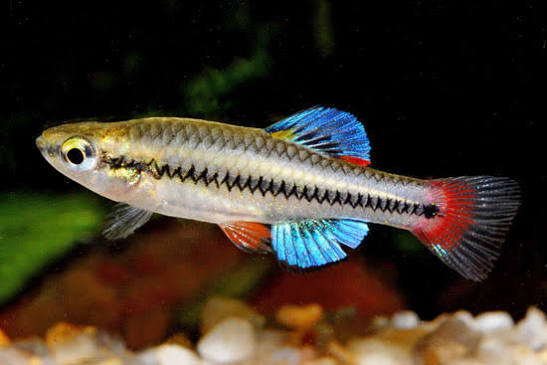
Lucania goodei
New Exclusive
| Qty (Stock) | Size | Sex | Unit price (Tax included) |
|---|---|---|---|
60 en stock | 1 ¾" | - | 14$ |
IMPORTANT
Keeping fish in an aquarium requires an ethical and responsible approach that prioritizes animal welfare. Purchasing fish for an aquarium should never be an impulsive decision. It is essential to understand the specific needs of each species, including water quality, aquarium size, behavior, and diet. Only fish with similar water quality requirements should be kept together in the same aquarium.
A Little More Information...
Lucania goodei is a small North American killifish valued for its strong sexual dimorphism and the blue tones displayed by mature males. Native mainly to the fresh waters of the southeastern United States, it inhabits quiet, shallow areas with abundant vegetation, including ditches, marshes, streams, and spring-fed habitats. Rather discreet yet active and rewarding to observe, it suits a planted aquarium designed around a subtropical environment. Its availability in the aquarium hobby is moderate: it is less common than widely traded livebearers or killifish, but remains accessible to aquarists looking for an unusual North American species.
General species description
Lucania goodei belongs to the family Fundulidae, a group of mainly North American killifish. It is a small, elongated and fairly sturdy species that usually stays near the surface or among plant cover. Males become especially attractive when displaying breeding colors, with metallic blue fins and red or orange markings. Females are plainer, commonly olive-brown or grayish. The species is adapted to quiet, well-oxygenated water and may also occur in habitats with some salt influence, although it is commonly kept in freshwater. It is active without being excessively restless and benefits from dense cover. In an aquarium, its behavior and coloration improve in a mature setup with a clear swimming surface, abundant plants and moderate water movement.
Geographical origin and biotope
Country of reference: United States. The species is native to the southeastern part of the country, especially Florida and southern Georgia, where it occurs in several coastal and inland watersheds. Its habitat includes slow streams, ditches, ponds, marshes, canals and spring-fed areas. Water may be clear or slightly stained, with shallow depth and slow to moderate current. Aquatic plants and marginal vegetation provide important cover for adults and young fish. In the aquarium, stable, well-filtered water that is soft to moderately mineralized is generally suitable. Excessive filtration should be avoided because it removes the quiet areas preferred by this fish. Floating plants also help reproduce the shaded light and plant cover found in its natural environment.
Precise location and local name
Lucania goodei is associated with the inland and coastal waters of Florida, as well as nearby areas of the southeastern United States. Its range includes several watersheds rather than one single river, which explains the variety of habitats where it occurs. In occupied areas, it is often found along quiet margins, among submerged plants or beneath floating vegetation. Its most widely used English common name is Bluefin killifish; some aquarium sources also use Bluefin topminnow. Local populations may differ in color and fin intensity, particularly among adult males. To preserve this variation, it is best to keep fish from the same locality together whenever their original collection site is known.
Appearance and physical characteristics
The body of Lucania goodei is fusiform, laterally compressed and covered with small scales. Its base coloration ranges from olive-brown to silvery gray, with a subtle lateral line and a darker back. Adult males have the brightest fins: the caudal and unpaired fins may show steel-blue, yellow, red or orange tones depending on mood, age and population. Females are usually more subdued, with translucent fins and less contrast. The mouth points upward, a common feature among fish that capture prey at the water surface. Maximum size is around 6 cm, while males may appear deeper-bodied and more colorful than females. A darkly decorated, planted aquarium naturally enhances the species’ contrast and display colors.
General diet
In the wild, Lucania goodei feeds mainly on small prey found in vegetation and at the water surface, including insect larvae, tiny crustaceans, worms and other aquatic invertebrates. It may also take zooplankton and small terrestrial prey that fall onto the surface. In an aquarium, a varied diet supports coloration and vitality. Live or frozen foods such as mosquito larvae, daphnia, brine shrimp and bloodworms are useful choices. Fine, high-quality dry foods may supplement the diet if the fish accept them. It is better to offer small portions once or twice daily than one large feeding. Newly introduced fish often respond best to moving prey. Removing leftovers helps maintain stable water quality, especially in a small, heavily planted aquarium.
Essential data
- Native river name: Several watersheds and streams in the southeastern United States
- Local name used: Bluefin killifish
- Origin of the scientific name: A genus established for a North American killifish; the specific epithet honors George Brown Goode
- Etymology of the complete name: Lucania refers to a geographical name used in nomenclature; goodei means “of Goode,” honoring George Brown Goode
- Common/vernacular names: Bluefin killifish; Bluefin topminnow
- Family: Fundulidae
- Subfamily: Fundulinae
- Name pronunciation: loo-KAY-nee-ah GOO-dee-eye
- Discovery: David Starr Jordan, 1880
- Maximum adult size: About 6 cm
- Water temperature and pH: About 18 to 25 °C; pH 6.5 to 8.0
- Stream appearance and surrounding vegetation: Quiet or slow water, often shallow, with submerged, floating and marginal plants
- Typical tankmates: Jordanella floridae, Gambusia holbrooki, Fundulus chrysotus, Elassoma evergladei, Poecilia latipinna
- Temperament and behavior: Active and generally peaceful; males may chase one another and defend small breeding areas
- Water depth: Shallow to moderate, especially along vegetated margins
- Sexual dimorphism: Males are more colorful, with bluish fins and often red or orange markings; females are duller and rounder
- Bottom structure and flow: Mud, sand or small plant debris; slow to moderate current
In your aquarium
For successful care of Lucania goodei, choose a mature, covered and well-planted aquarium with gentle filtration, shaded areas and accessible surface space. A subtropical temperature, clean water and a varied diet are the most important foundations. Floating plants and dense vegetation reduce stress and provide spawning sites. Keep several females with each male to limit repeated chasing. Because the species is less frequently offered than the most popular killifish, avoid mixing localities if you want to preserve an identifiable line. A stable routine and moderate water changes will highlight its blue fins and natural behavior.
{913}