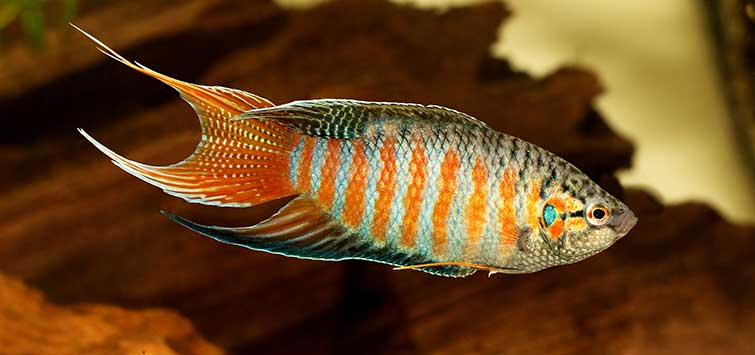
Macropodus opercularis
| Qty (Stock) | Size | Sex | Unit price (Tax included) |
|---|---|---|---|
| Currently Out of Stock! Contact us for more information | |||
IMPORTANT
Keeping fish in an aquarium requires an ethical and responsible approach that prioritizes animal welfare. Purchasing fish for an aquarium should never be an impulsive decision. It is essential to understand the specific needs of each species, including water quality, aquarium size, behavior, and diet. Only fish with similar water quality requirements should be kept together in the same aquarium.
A Little More Information...
Macropodus opercularis is a freshwater labyrinth fish from eastern Asia, valued for its hardiness, coloration, and distinctive behavior. Commonly called the paradise fish, it possesses an organ that allows it to use atmospheric air when water contains little oxygen. Despite its modest size, it remains territorial, especially when male, and requires thoughtful community planning. It does best in a well-covered, planted aquarium with sheltered areas. This common aquarium species suits aquarists who want to observe an active, curious fish with a strong personality. Its surface activity and breeding behavior add considerable interest to a properly arranged freshwater aquarium.
General description of the species
Macropodus opercularis belongs to the family Osphronemidae, a group that includes gouramis and other Asian labyrinth fishes. It is a freshwater fish able to absorb part of its oxygen from atmospheric air through its labyrinth organ. In nature, it inhabits calm, shallow environments where vegetation provides shelter and spawning sites. In an aquarium, its behavior is usually most interesting when the layout is structured rather than completely open. Males may defend territories and can be aggressive toward one another, so keeping several individuals requires suitable space and visual barriers. The species is hardy, active, and fairly adaptable, but this resilience does not replace stable water quality or appropriate filtration. Its popularity comes from its coloration, surface-oriented behavior, and ability to adapt to a range of temperate to tropical freshwater aquariums.
Geographical origin and biotope
Countries of reference: China, Taiwan, Vietnam, and Laos. Macropodus opercularis is native to eastern Asia and occupies slow-moving or stagnant waters, including ditches, rice fields, ponds, canals, and quiet sections of small streams. These habitats are often shallow, warmed by sunlight, and rich in marginal or submerged vegetation. The water may be clear or slightly stained by organic matter, with mud, sand, or plant debris covering the bottom. Flow is weak and may be almost absent. In an aquarium, this origin translates into a preference for accessible surface water, moderate circulation, and dense planting. A temperature around 20 to 26 °C is generally suitable, with soft to moderately hard water and a pH approximately between 6.0 and 8.0. Seasonal changes occur across parts of its natural range.
Precise location and local name
Macropodus opercularis is associated with lowland waters and calm drainage systems in southern China, as well as Taiwan and parts of northern Indochina. Its range includes areas connected with the Pearl River and Yangtze basins, although the species has also been moved or introduced elsewhere. In the aquarium trade, its most common names are paradise fish, Chinese paradise fish, and Chinese fighting fish. The English name paradise fish is widely used. Older or commercial sources may use Chinese fighting fish, referring to its territorial confrontations. These names describe aquarium use or behavior and do not replace the scientific name. Its low rarity rating reflects a species readily available through the aquarium trade, although local populations may show differences in coloration or body form. A covered aquarium is particularly useful because the fish regularly visits the surface.
Appearance and physical characteristics
Macropodus opercularis has an elongated, laterally compressed body with long unpaired fins. Its basic coloration may include reddish brown, blue, or green tones, with darker vertical bands and metallic reflections. The fins often show red, orange, or bluish shades, especially in males during breeding condition. Adult males are generally larger and more strongly colored than females, with more developed dorsal, anal, and caudal fins. The caudal fin may spread broadly, while the pelvic fins are thin and extended. Maximum size is commonly reported at about 10 cm, depending on the measurement method and strain. The species has a forward-facing mouth and a subtle lateral line. Its most important anatomical feature is the labyrinth organ, which allows it to supplement gill respiration by taking air at the surface. A dark background and dense plants can help its natural colors stand out.
General diet
Macropodus opercularis is an opportunistic omnivore. In nature, it feeds on small aquatic and terrestrial invertebrates, insect larvae, tiny crustaceans, and other available surface resources. In an aquarium, a quality staple diet of pellets or flakes can be supplemented with frozen or live foods. Mosquito larvae, brine shrimp, daphnia, and bloodworms can encourage hunting behavior and support condition, but should be offered in moderation. A varied diet helps maintain color and vitality without adding excessive organic waste. Small portions that are eaten quickly are preferable. Juveniles benefit from fine foods suited to their mouths. Because the species readily feeds near the surface, floating or slow-sinking foods are often practical. It should not be treated only as an insect predator: it benefits from a varied, balanced, and consistent diet that includes both prepared foods and suitable animal-based supplements.
Essential data
- Name of the original river: Pearl River and associated calm-water systems
- Local name used: Paradise fish; Chinese paradise fish
- Origin of the scientific name: Macropodus refers to large fins or large feet; opercularis means relating to the operculum
- Etymology of the full name: Macropodus comes from the Greek makros, large, and pous/podos, foot; opercularis comes from the Latin operculum, cover, referring to the gill cover
- Common/vernacular names: Paradise fish, Chinese paradise fish, Chinese fighting fish
- Family: Osphronemidae
- Subfamily: Macropodinae
- Name pronunciation: mak-roh-POH-dus - oh-per-kyoo-LAIR-iss
- Discovery: Carl Linnaeus, 1758
- Maximum adult size: About 10 cm
- Water temperature and pH: 20 to 26 °C; pH 6.0 to 8.0
- Stream appearance and surrounding vegetation: Slow-flowing waters, ponds, rice fields, ditches, and canals with dense marginal or submerged vegetation and calm surface areas
- Typical tankmates: Tanichthys albonubes, peaceful loaches of similar size, robust danios, and other calm fish that avoid long fins
- Temperament and behavior: Active and territorial; males may fight and defend a sector, especially during breeding
- Water depth: Shallow to moderate, particularly in calm shoreline areas
- Sexual dimorphism: Male usually more colorful and larger, with longer and more developed fins; female generally stockier and less brightly colored
- Bottom structure and flow: Mud, sand, and plant debris; weak flow or stagnant water
In your aquarium
To succeed with Macropodus opercularis, provide a covered aquarium, accessible surface water, and planting that creates visual boundaries. Excessive flow can tire the fish and remove the calm areas it prefers. Males should be watched carefully because their territorial behavior can cause injuries, especially in an open layout without shelters. Stable water, a varied diet, and peaceful companions with short fins support long-term maintenance. The temperature can remain moderate rather than excessively warm. With these precautions, this colorful and hardy fish becomes an excellent subject for aquarists who enjoy natural behavior and want a species with strong character.
{996}