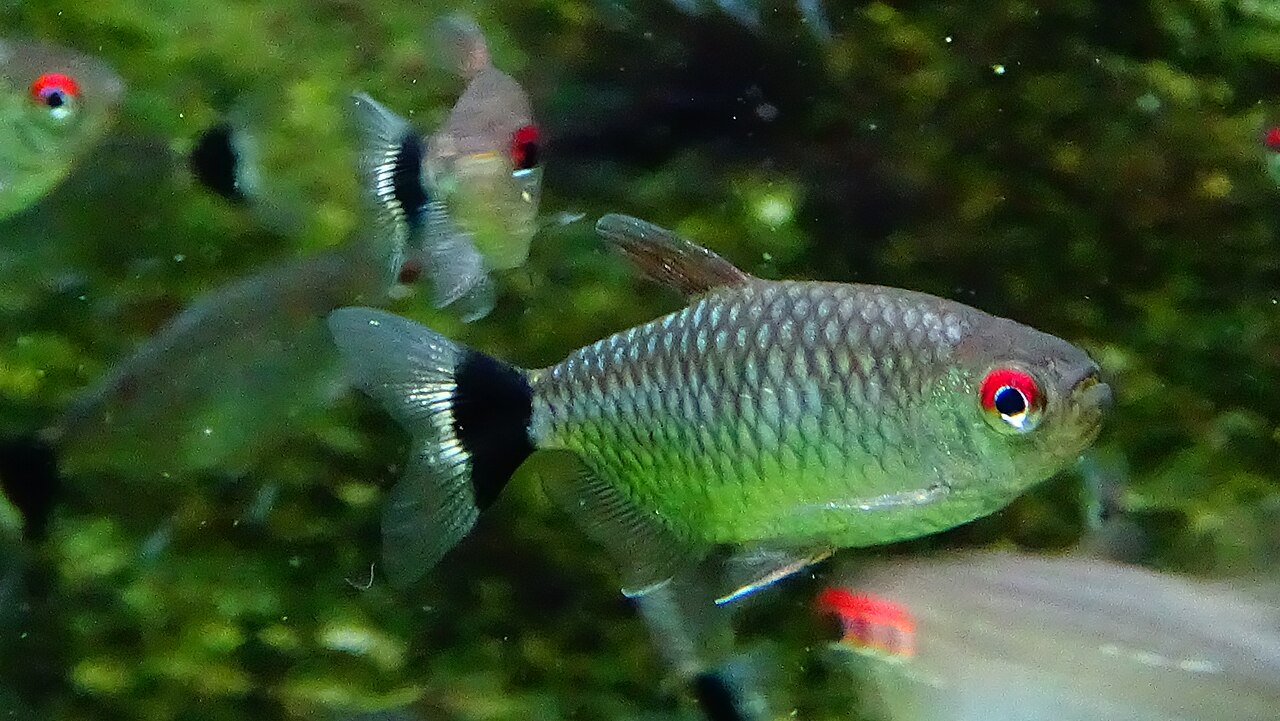
Moenkhausia sanctaefilomenae Red Eye Tetra
| Qty (Stock) | Size | Sex | Unit price (Tax included) |
|---|---|---|---|
| 1 ½" | - | 7$ |
IMPORTANT
Keeping fish in an aquarium requires an ethical and responsible approach that prioritizes animal welfare. Purchasing fish for an aquarium should never be an impulsive decision. It is essential to understand the specific needs of each species, including water quality, aquarium size, behavior, and diet. Only fish with similar water quality requirements should be kept together in the same aquarium.
A Little More Information...
Moenkhausia sanctaefilomenae, also known as the Red Eye Tetra, is a small South American characin valued for its silver eye ringed in red, sturdy nature, and schooling behavior. Very common in the aquarium hobby, it brings movement to the middle levels of a peaceful community aquarium when kept in a proper group. Its silver body reflects light attractively, while the fins may show yellowish or reddish shades. Peaceful, active without being aggressive, and usually easy to feed, it suits aquarists looking for a dynamic school, provided the water remains stable and the swimming area is adequate.
General species description
Moenkhausia sanctaefilomenae is a medium-sized tetra in the aquarium trade, with a streamlined body that is slightly compressed from side to side. It is a schooling fish and shows more natural behavior when kept in groups of at least six, preferably more. In a well-planned aquarium, it mainly occupies the middle water column and continually explores its surroundings. Its temperament is peaceful, but its steady activity calls for similarly sized tank mates. The species is very common in the hobby and adapts to a broad range of conditions when sudden changes are avoided. Efficient filtration, well-oxygenated water, and plants or roots that provide cover help reduce nervousness. It is not territorial; brief chases between individuals generally reflect social ranking or courtship behavior.
Geographic origin and biotope
Countries of reference: Brazil, Bolivia, and Paraguay. Moenkhausia sanctaefilomenae is associated with the Paraná and Paraguay basins, including tropical streams, tributaries, and quiet areas connected with floodplains. Its natural habitat includes slow- to moderate-flowing sections, often bordered by riparian vegetation, branches, and plant debris. Light may be softened by vegetation or forest cover, while the bottom is generally made up of sand, silt, and organic matter. In an aquarium, plants, wood, and a dark substrate create a more suitable setting than a completely bare layout. Moderate circulation, good oxygenation, and a stable temperature around 24 to 27 °C are well suited to its care.
Precise location and local name
The species reference locality is the Rio das Velhas, near Lagoa Santa, in the Brazilian state of Minas Gerais. Its range also extends through several river systems in central and southern South America. In the trade, the most common names are Red Eye Tetra, red-eye tetra, and the Portuguese name tetra olho-vermelho. The English name directly describes its most noticeable feature: the red ring around the eye. Since several silver tetras may be sold under similar trade names, identification should be based on the combination of the red eye, silver body, and dark fin markings. The species is nevertheless easy to recognize when observed as a school.
Appearance and physical characteristics
The body of Moenkhausia sanctaefilomenae is silver, elongated, and laterally compressed, with a slightly arched dorsal profile. The eye has a bright red ring, the feature that inspired its common name. The dorsal, anal, and caudal fins may display yellow, orange, or reddish shades, often together with black markings. The caudal fin is forked, and the body shape is suited to continual swimming in open water. Adult females are generally fuller-bodied than males, especially when carrying eggs; males tend to remain slimmer. Aquarium specimens commonly reach about 5 to 6 cm, depending on diet, available space, and care quality. Pale coloration may appear after stress, while a comfortable school shows clearer colors.
General diet
Moenkhausia sanctaefilomenae is an omnivore and readily accepts a varied diet. A base of small quality pellets or flakes can be supplemented with small frozen or live foods such as brine shrimp, daphnia, and bloodworms. Portions should be small enough to be eaten quickly because the fish has a relatively small mouth. Offering one or two small meals per day helps limit waste and supports good body condition. A varied diet supports coloration, activity, and growth, and a specialized vegetable food is not essential. Juveniles benefit from finer foods and more frequent meals. Observe the school during feeding to make sure less dominant individuals receive their share.
Essential data
- River of origin: Rio das Velhas
- Local name used: Tetra olho-vermelho
- Origin of the scientific name: Genus dedicated to William J. Moenkhaus; species epithet associated with Santa Filomena
- Etymology of the full name: Moenkhausia honors Moenkhaus; sanctaefilomenae means of Saint Philomena
- Common/vernacular names: Red Eye Tetra, red-eye tetra
- Family: Characidae
- Subfamily: Stethaprioninae
- Name pronunciation: moenk-HOW-zee-ah - sank-tay-fee-lo-MEE-nay
- Discovery: Franz Steindachner, 1907
- Maximum adult size: About 6 cm
- Water temperature and pH: 22 to 28 °C; pH 6.0 to 8.0
- Stream appearance and surrounding vegetation: Quiet to moderately flowing tropical tributaries, riparian vegetation, branches, and plant debris
- Typical tank mates: Corydoras agassizi, Hoplisoma paleatus, Ancistrus cirrhosus, Apistogramma agassizii Tefe
- Temperament and behavior: Peaceful, schooling, and active in open water
- Water depth: Shallow to intermediate areas, especially near banks and cover
- Sexual dimorphism: Female usually rounder; male more slender
- Bottom structure and flow: Sand, silt, and organic debris; slow to moderate current
In your aquarium, success depends on a sufficiently large school, stable water, and open swimming space. Provide a planted layout with shaded areas, gentle but effective filtration, and varied food in small portions. Because it is a very common and adaptable fish, Moenkhausia sanctaefilomenae works well in a peaceful community aquarium, but it should not be housed with species large enough to view it as prey.
{1022,202,21,692}