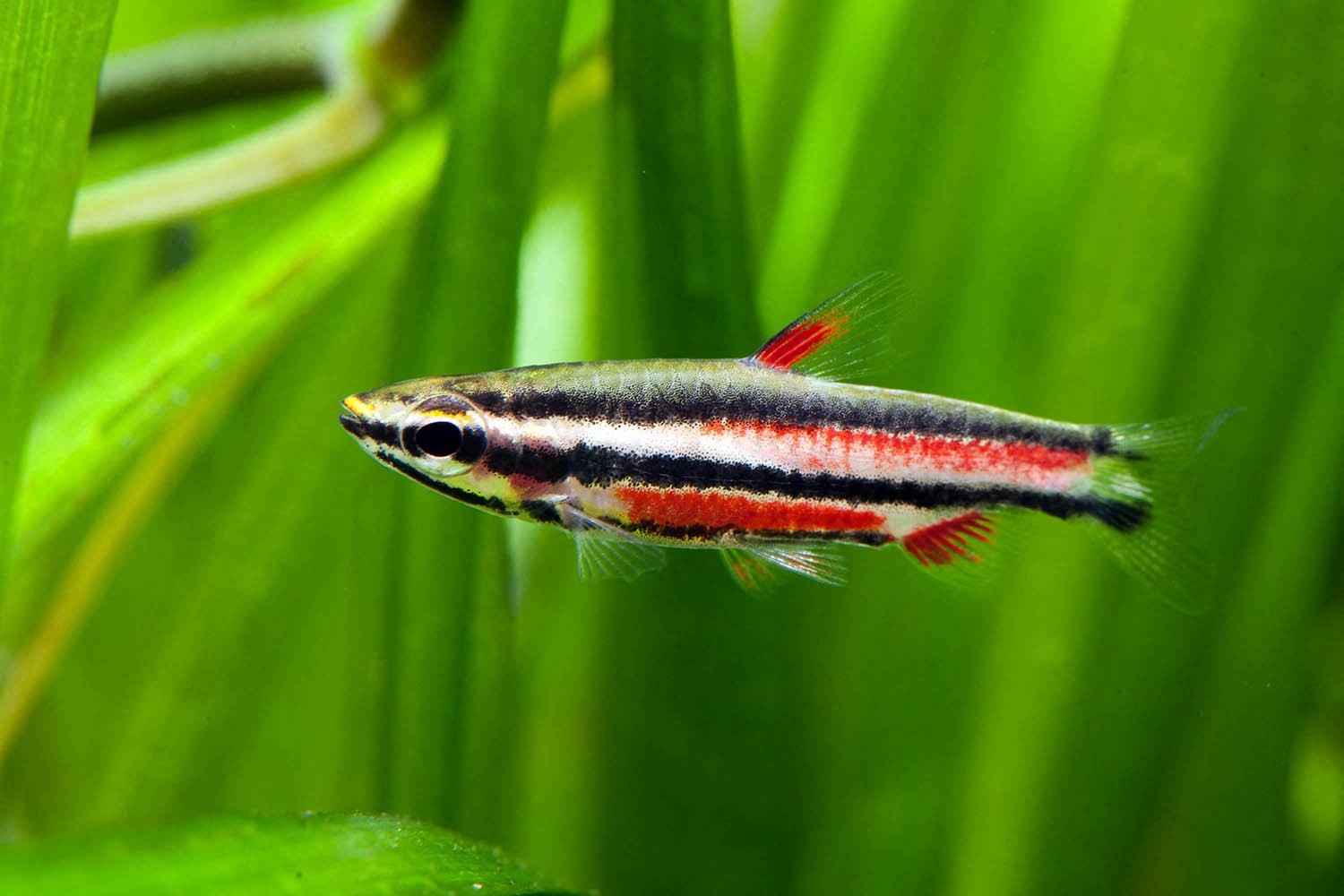
Nannostomus rubrocaudatus Lápis Peruano
New
| Qty (Stock) | Size | Sex | Unit price (Tax included) |
|---|---|---|---|
| Currently Out of Stock! Contact us for more information | |||
IMPORTANT
Keeping fish in an aquarium requires an ethical and responsible approach that prioritizes animal welfare. Purchasing fish for an aquarium should never be an impulsive decision. It is essential to understand the specific needs of each species, including water quality, aquarium size, behavior, and diet. Only fish with similar water quality requirements should be kept together in the same aquarium.
A Little More Information...
Nannostomus rubrocaudatus, also known as Lápis Peruano, is a small pencilfish native to Peru’s Amazonian region. Its slender body, peaceful nature, and red tail make it an appealing choice for a well-planted community aquarium. This species usually swims in the upper part of the water column and appreciates plants, roots, and subdued lighting. Like other pencilfish, it is best kept in a group, which encourages natural behavior and reduces shyness. Its small adult size allows it to be housed in many peaceful aquariums, as long as its tankmates are similarly small and gentle.
General species description
Nannostomus rubrocaudatus belongs to the South American pencilfishes, slender characiforms adapted to life near the surface. It is a small schooling species that is generally peaceful and more confident when maintained with several companions. In an aquarium, it spends most of its time in the upper and middle levels, making quick but controlled movements. Its appeal comes from both its coloration and its discreet, coordinated behavior. Fine-leaved plants, wood, and shaded areas make the fish easier to observe and help it feel secure. It is suitable for a calm community aquarium without aggressive fish or large predators. Its availability is generally good in the aquarium trade, and it is considered a very common pencilfish among species offered to aquarists.
Geographical origin and biotope
Nannostomus rubrocaudatus is associated with Peru in the Amazon Basin, particularly the Rio Nanay and nearby small tributaries. Its natural habitat consists of forest streams with low to moderate flow, often influenced by organic material falling from the surrounding rainforest. The water is usually soft and acidic, and may range from clear to tea-colored depending on the amount of tannins. Quiet margins, backwaters, and areas filled with branches provide shelter and feeding grounds. In an aquarium, stable, soft, slightly acidic water is best suited to its natural adaptation. Gentle filtration is preferable to strong current. Leaves, roots, and floating plants can help create a more natural setting and enhance the fish’s warm tail coloration.
Precise location and local name
Known populations come from northeastern Peru, in the Amazonian region around Iquitos, especially within the Rio Nanay drainage. The species is associated with quiet marginal habitats rather than the fastest-flowing sections of the main river. The local or trade name supplied for this fish is Lápis Peruano, a Spanish expression meaning “Peruvian pencil.” The name refers to its slim, elongated shape and its geographic origin. In the international aquarium trade, Red-tailed Pencilfish and Peru Red-tailed Pencilfish may also be used, but Lápis Peruano is the vernacular name specified here. To avoid confusion, the scientific name should be checked when purchasing, since several pencilfish have a similar body shape.
Appearance and physical characteristics
Nannostomus rubrocaudatus has a slim, elongated body that is slightly compressed from side to side, as is typical of pencilfish. Its base color ranges from silvery to golden brown, with a dark longitudinal stripe emphasizing the body profile. Its most distinctive feature is the red tail, which is especially noticeable when the fish is healthy and kept in suitable water. Some fins may also show reddish tones. The small terminal mouth is directed forward and is suited to taking tiny prey near the surface. Adult males may display stronger colors and a slightly slimmer shape, while females are often rounder when carrying eggs. Adult size remains modest, making the species suitable for a reasonably sized planted aquarium. Subdued lighting and a dark background bring out its red and black contrasts.
General diet
In nature, Nannostomus rubrocaudatus mainly feeds on very small prey and organisms drifting near the surface. In the aquarium, its diet should combine very small prepared foods with frozen or live foods. Fine micro-pellets, finely crushed flakes, baby brine shrimp, cyclops, and small daphnia are usually suitable. Regular access to live or frozen foods encourages hunting behavior and helps maintain strong coloration. Because its mouth is small, oversized foods may be difficult to eat or may be ignored. Offer small portions once or twice daily and remove uneaten food to protect water quality. A varied diet rich in tiny prey is the best foundation for maintaining strong tail coloration and stable body condition.
Essential data
- Origin river: Rio Nanay
- Local name used: Lápis Peruano
- Origin of the scientific name: The name refers to the species’ morphological traits and coloration.
- Etymology of the full name: Nannostomus comes from the Greek nanos, small, and stoma, mouth; rubrocaudatus comes from the Latin ruber, red, and caudatus, having a tail.
- Common/vernacular names: Lápis Peruano; Red-tailed Pencilfish; Peru Red-tailed Pencilfish
- Family: Lebiasinidae
- Subfamily: Lebiasininae
- Name pronunciation: nan-oh-STOH-muss roo-broh-kaw-DAH-tuss
- Discovery: Stanley H. Weitzman and Marilyn J. Weitzman, 2002
- Maximum adult size: About 3.5 cm
- Water temperature and pH: 24 to 28 °C; pH 5.0 to 7.0
- Stream appearance and surrounding vegetation: Quiet forest streams with roots, branches, leaf litter, and submerged vegetation along the margins.
- Typical tankmates: Small pencilfish, small peaceful tetras, small Corydoras, and small Otocinclus.
- Temperament and behavior: Peaceful, schooling, and sometimes shy; mainly active in the upper and middle levels.
- Water depth: Shallow marginal areas, backwaters, and small tributaries.
- Sexual dimorphism: Females are generally rounder; males are often slimmer and more colorful.
- Bottom structure and flow: Sandy or muddy bottoms covered with plant debris; low to moderate flow.
For greater success
To keep Nannostomus rubrocaudatus successfully, use a mature, covered aquarium furnished with plants, roots, and shaded areas. A reasonably sized group makes the fish more confident and allows natural interactions to be observed. Maintain soft, stable, slightly acidic water with moderate flow and excellent water quality. Avoid boisterous, oversized, or predatory tankmates. Fine, varied foods offered in small portions complete the setup. The red tail is most attractive under subdued lighting and against a dark background. With these conditions, this peaceful and colorful species is an excellent choice for an Amazonian community aquarium.
{}