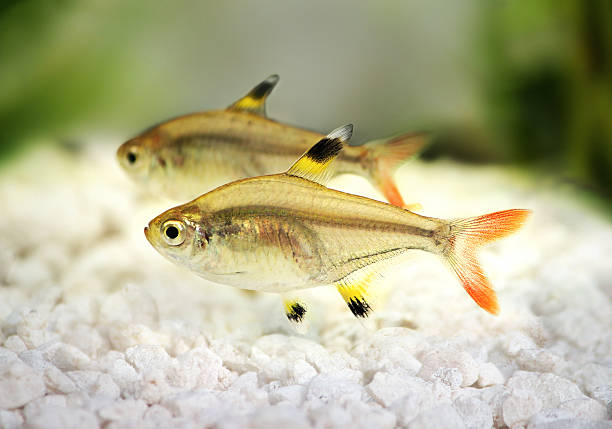
Pristella maxillaris X-Ray Tetra
New
| Qté (Stock) | Taille | Sexe | Prix unitaire (Taxes incluses) |
|---|---|---|---|
| 1 ½" | - | 6$ 12 pour 56$ |
IMPORTANT
La possession de poissons en aquarium requiert une approche éthique et responsable pour respecter les animaux. L'acquisition de poissons pour maintenance en aquarium ne doit pas se faire sur un coup de tête (achat impulsif). Il est essentiel de s'informer sur les besoins spécifiques des espèces (qualité eau, dimensions aquarium, comportement, alimentat). Seuls les poissons ayant des exigences similaires en matière de qualité d'eau devraient être maintenus ensemble dans un même aquarium.
Un peu plus d'informations...
The Pristella maxillaris, also known as the X-Ray Tetra, is a small South American characid valued for its translucent body and contrasting fins. Its delicate outline can look almost radiographic, especially when it swims in a group under subdued lighting. Generally peaceful, it suits well-planned community aquariums and should be kept in a shoal. This species remains very common in the aquarium trade, making it accessible to beginners. Its hardiness, modest adult size, and social behaviour make it a versatile choice for a planted tropical aquarium. Stable water quality and a varied diet are the main foundations of long-term success.
General description
The Pristella maxillaris is a small schooling fish in the family Characidae, mainly active in the middle levels of the aquarium. It is recognized by its silvery, translucent body, which reveals part of its internal structure, along with dorsal, anal, and caudal fins marked with yellow, black, and white. Adults usually reach about 3.5 to 4 cm. Peaceful by nature, it should be kept in groups of at least six, preferably more, to encourage natural behaviour and reduce nervousness. It uses open areas near plants and roots, forming a constantly moving shoal. Availability in the trade is high, so this is a very common species rather than a rare one. It generally adapts well when introduced to a mature aquarium.
Geographic origin and biotope
Native to northern South America, the Pristella maxillaris is associated with several river systems in the Guianas, Venezuela, and Brazil. Reference countries: Brazil, Guyana, and Venezuela. It inhabits tributaries, small streams, and quieter river margins, often near flooded banks and areas with abundant vegetation. The water may be clear or slightly stained by organic matter, with stable tropical temperatures and low to moderate flow. Its habitat commonly includes branches, roots, leaf litter, and submerged or marginal plants. In the aquarium, clean, well-oxygenated water ranging from slightly acidic to neutral, combined with gentle circulation, provides a suitable general approximation of its natural conditions. Cover and shaded areas can help it feel secure.
Precise location and local name
One population is associated with the Essequibo River in Guyana, while the species is also recorded from different drainage systems in northern South America. Its natural distribution is not restricted to a single river and may vary among populations and references. In Portuguese-speaking regions, the descriptive name tetra-raio-X is used; internationally, X-Ray Tetra is the most widespread trade name. In French-speaking aquariums, “tetra rayon X” or “transparent tetra” are understandable names, although X-Ray Tetra is also commonly used. Fish sold by retailers are generally captive-bred, which explains their consistent availability. Select active, well-proportioned specimens with intact fins.
Appearance and physical characteristics
The body of the Pristella maxillaris is short, laterally compressed, and partly transparent, with a silvery tone that reflects light. The base of the dorsal fin shows yellow and black, while the anal fin also has contrasting areas; the caudal fin may display reddish or orange tones in some specimens. Transparent fins enhance the visual effect that inspired the English name X-Ray Tetra. Adult females are often larger and rounder than males, especially when carrying eggs. Males tend to remain slimmer. Colour intensity can change with mood, lighting, water quality, and strain. Long-finned or selectively coloured forms do not necessarily represent the typical wild appearance. The transparent body is particularly noticeable when the fish is viewed from the side against a dark background.
General diet
The Pristella maxillaris is an omnivore and readily accepts a varied aquarium diet. A quality small-particle dry food can form the base, but it should be supplemented with frozen or live foods of suitable size. Baby brine shrimp, small daphnia, mosquito larvae, and cyclops encourage feeding behaviour and help maintain condition. It feeds mainly in the water column, quickly taking floating or sinking particles. Offer small portions that are consumed within a few minutes to protect water quality. A varied diet, including regular small protein-rich foods, supports vitality and breeding. Avoid overfeeding, especially in a densely stocked aquarium. Foods should be small enough for the fish to swallow comfortably, and occasional fasting is unnecessary when portions are already carefully controlled.
Essential data
- River of origin: Essequibo River
- Local name used: Tetra-raio-X; X-Ray Tetra in the international trade
- Origin of the scientific name: Pristella is the genus name and maxillaris is the specific epithet assigned during the scientific description
- Full-name etymology: Pristella is a diminutive generic name; maxillaris means relating to the jaw
- Common/vernacular names: X-Ray Tetra, X-ray fish, pristella
- Family: Characidae
- Subfamily: Stethaprioninae
- Name pronunciation: pris-TEL-la mak-si-LA-ris
- Discovery: Albert B. Ulrey, 1894
- Maximum adult size: Approximately 4.5 cm
- Water temperature and pH: 23 to 28 °C; approximately pH 6.0 to 8.0
- Stream appearance and surrounding vegetation: Small streams and quiet margins with roots, leaf litter, branches, and riparian vegetation
- Typical tankmates: Small peaceful characids, corydoras, and bottom fish suited to the same parameters
- Temperament and behaviour: Peaceful, schooling, and active in the middle levels
- Water depth: Shallow areas near banks and flooded margins
- Sexual dimorphism: Females generally larger and rounder; males slimmer
- Bottom structure and flow: Sand or mud with leaf litter and plant debris; low to moderate flow
In your aquarium
To succeed with the Pristella maxillaris, use a mature, covered, fully cycled aquarium with stable water conditions and open swimming space. A group of at least six, along with plants, roots, and moderate lighting, will help the fish display natural behaviour. Keep filtration effective, but avoid excessively strong current. Compatibility with small peaceful fish is usually straightforward, provided predatory or overly aggressive species are excluded. A varied diet and regular small water changes complete the essential care routine. Because the species is very common, choose active, well-formed fish with undamaged fins when purchasing. Gradual acclimation is still recommended, even for this adaptable tetra.
{1120}