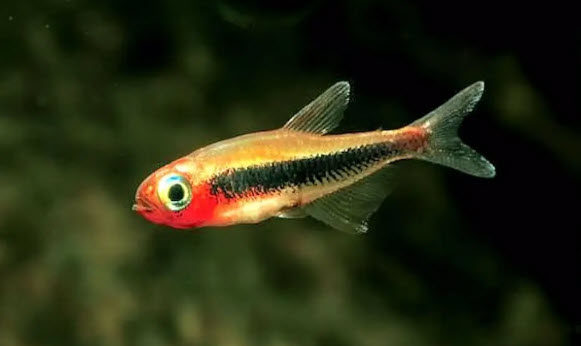
Tucanoichthys tucano Toucan Tetra
Wild caught origin Exclusive
| Qté (Stock) | Taille | Sexe | Prix unitaire (Taxes incluses) |
|---|---|---|---|
| ¾" | - | 17$ |
IMPORTANT
La possession de poissons en aquarium requiert une approche éthique et responsable pour respecter les animaux. L'acquisition de poissons pour maintenance en aquarium ne doit pas se faire sur un coup de tête (achat impulsif). Il est essentiel de s'informer sur les besoins spécifiques des espèces (qualité eau, dimensions aquarium, comportement, alimentat). Seuls les poissons ayant des exigences similaires en matière de qualité d'eau devraient être maintenus ensemble dans un même aquarium.
Un peu plus d'informations...
A tiny freshwater characid from the Rio Negro basin of Brazil, Tucanoichthys tucano, also known as the Toucan Tetra, is recognized for its minute size and subtle coloration. This schooling species inhabits calm, shaded and vegetation-rich areas of small Amazonian streams. Its rarity in the aquarium trade makes it a sought-after fish among specialist aquarists. The specimens offered here are wild-collected, and this species is exclusive to Ton.Fish in Canada. It nevertheless requires soft, warm and acidic water, very small foods and careful acclimation. Stable conditions are more important than intensive lighting or a heavily decorated aquarium.
General description
Tucanoichthys tucano is a very small South American tetra that should be kept in a group to encourage natural behavior. It mainly uses the upper and middle areas of the aquarium, moving in short bursts among plants, roots and leaf litter. Its temperament is peaceful, but its tiny size requires calm, non-predatory tank mates. A group of at least 8 to 10 fish provides greater security and makes social behavior easier to observe. Because it is considered very rare here, slow acclimation, stable water and a mature aquarium are preferable to intense lighting or frequent rearrangement of the décor.
Geographic origin and habitat
This species comes from Brazil, in the upper Rio Negro basin, particularly around the Rio Uaupés and its smaller tributaries. It inhabits shaded forest sections, often shallow, where roots, fallen leaves and branches locally reduce the current. The water is soft and generally acidic, with low mineral content. In the aquarium, gentle filtration, subdued lighting and wood or leaf litter reproduce its environment more effectively than a bare setup. Practical target values are a temperature of 24 to 28 °C and a pH around 4.5 to 6.5, with excellent stability.
Specific location and local name
The known distribution is associated with the upper Rio Uaupés, in Amazonas State, near the São Gabriel da Cachoeira region and the Iauaretê area. The scientific name directly refers to the Tucano peoples of this part of Amazonia. In the aquarium trade, the most common name is Toucan Tetra; “Tucano Tetra” is also used. Its restricted range and irregular availability help explain its status as a very rare fish among specialist retailers.
Appearance and physical characteristics
The body of Tucanoichthys tucano is very small, slender and slightly compressed from side to side. Overall coloration ranges from translucent to silvery, with pinkish or golden tones depending on lighting and condition. A darker tone may appear along the back and at the base of the caudal fin, while the fins remain subtle. Adult size is close to 2 cm, making this a true nano-fish. Its delicate profile and small mouth require very fine foods. The coloration is best displayed in lightly tinted water, under moderate lighting and against a dark background.
General diet
In nature, Tucanoichthys tucano presumably feeds on very small prey and drifting organisms in the water column. In aquaria, it accepts finely crushed flakes, micro-pellets and appropriately sized frozen foods. Baby brine shrimp, cyclops and small insect larvae are good options when available. It is better to provide small portions several times a day than one large meal. Food should remain suspended long enough for this delicate midwater fish to catch it. A varied diet supports coloration, body condition and acclimation success in wild-collected specimens.
Essential data
- River of origin: Rio Uaupés
- Local name used: Tucano Tetra; Toucan Tetra
- Origin of the scientific name: The genus honors the Tucano peoples; “ichthys” means fish in Greek.
- Etymology of the complete name: Tucanoichthys means “fish of the Tucano”; tucano refers to the people and ichthys means fish. Tucano is also used as the specific epithet.
- Common/vernacular names: Toucan Tetra, Tucano Tetra
- Family: Characidae
- Subfamily: Characinae
- Pronunciation: too-kah-no-ik-this too-kah-no
- Discovery: Jacques Géry, 1973
- Maximum adult size: About 2 cm
- Water temperature and pH: 24 to 28 °C; pH 4.5 to 6.5
- Appearance of the watercourse and surrounding vegetation: Shaded forest streams with soft, acidic water, leaf litter, roots and submerged branches.
- Typical tank mates: Paracheirodon axelrodi, Carnegiella strigata, Apistogramma uaupesi
- Temperament and behavior: Peaceful, schooling and somewhat shy; it is more confident in a group.
- Water depth: Shallow areas and quiet margins of small tributaries.
- Sexual dimorphism: Females are usually rounder when carrying eggs; young fish are difficult to sex.
- Bottom structure and flow: Fine sand, fallen leaves, roots and wood; low to moderate flow.
In your aquarium
Success depends on a mature, covered aquarium with subdued lighting and filtration that does not create excessive current. Keep Tucanoichthys tucano in a group and avoid fish large enough to swallow it or outcompete it for food. Wild-collected specimens benefit from gradual acclimation, very stable water and tiny foods offered regularly. Since this is a very rare species exclusive to Ton.Fish in Canada, preventive care—quarantine, gentle maintenance and regular water changes—is especially important.
{168,543,425}