Campylomormyrus tamandua
Liste de poissons Varia Campylomormyrus tamandua
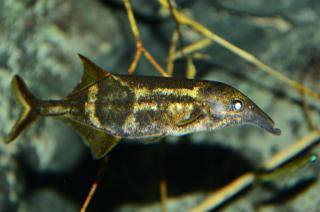
Campylomormyrus tamandua Worm Jawed African Elephantnose
Origine sauvage Exclusivité
| Qté (Stock) | Taille | Sexe | Prix unitaire (Taxes incluses) |
|---|---|---|---|
| Aucun en stock en ce moment! Communiquez avec nous | |||
IMPORTANT
La possession de poissons en aquarium requiert une approche éthique et responsable pour respecter les animaux. L'acquisition de poissons pour maintenance en aquarium ne doit pas se faire sur un coup de tête (achat impulsif). Il est essentiel de s'informer sur les besoins spécifiques des espèces (qualité eau, dimensions aquarium, comportement, alimentat). Seuls les poissons ayant des exigences similaires en matière de qualité d'eau devraient être maintenus ensemble dans un même aquarium.
Un peu plus d'informations...
Campylomormyrus tamandua, also called the Worm Jawed African Elephantnose, is an African weakly electric fish with a highly distinctive profile. Its elongated, curved snout gives it an instantly recognizable appearance, while its electric organs help it navigate dark water. Native to the Congo Basin, it mainly inhabits quiet areas rich in shelter and organic matter. This species remains uncommon in the aquarium trade and is best suited to aquarists able to provide stable water, a suitable layout, and a varied diet based on small prey.
General species description
Campylomormyrus tamandua belongs to the Mormyridae, a family of African fishes characterized by a weak electric organ and specialized sensory systems. It is mainly active during twilight and at night. It produces weak electrical discharges that help it perceive its surroundings, locate food, and communicate. In an aquarium, it benefits from a calm atmosphere, subdued lighting, and numerous hiding places. This is not a fish for a highly active community aquarium: its specialized needs and sensitivity to unstable conditions require thoughtful care. Its availability is moderate, making it less common than the well-known elephantnose fish, Gnathonemus petersii, but it can usually be obtained from specialized suppliers.
Geographical origin and biotope
Reference countries: Democratic Republic of the Congo and Republic of the Congo, within the Congo Basin. The species is associated with forest waterways and river areas where the current is low to moderate. Its habitat includes wooded banks, submerged roots, leaf deposits, and sandy or muddy bottoms. The water is generally warm, soft to moderately acidic, and often darkened by tannins and suspended organic matter. In an aquarium, a temperature of 24 to 28 °C and a pH around 6.0 to 7.5 are useful general targets, along with strong filtration and regular water changes.
Precise location and local name
Campylomormyrus tamandua is mainly associated with the Congo River drainage, in forested areas where slow water provides shelter and an abundance of small prey. The trade primarily uses the English name Worm Jawed African Elephantnose, rather than a standardized regional vernacular name. In the aquarium hobby, it may also be described as a worm-jawed elephantnose fish. The species is not a strict schooling fish; instead, it requires a quiet, structured environment with roots, tubes, and shaded areas. A tank of at least 300 litres is a cautious starting point for an adult, with generous floor space and a tightly fitted cover.
Appearance and physical characteristics
The body is elongated and laterally compressed, usually grayish brown to dark brown, with subtly colored fins. Its most remarkable feature is the tubular, strongly extended snout, which resembles a small trunk or curved jaw. This structure is used to search the substrate and crevices for food. Like other Mormyridae, it has a low-intensity electric organ and receptors capable of detecting disturbances in the electrical field. The caudal fin is clearly separated from the body, while the dorsal and anal fins are positioned well toward the rear. Adult size may reach approximately 25 cm.
General diet
In nature, Campylomormyrus tamandua searches for small prey on the bottom and among plant debris. Its specialized snout allows it to probe sand, mud, leaves, and crevices. In an aquarium, offer a varied carnivorous diet including bloodworms, brine shrimp, small worms, aquatic larvae, and quality sinking foods. Frozen or live foods are often accepted more readily than flakes. Feeding at dusk is preferable, when the fish becomes more active. Regularly offering small portions helps reduce feeding competition and maintain condition without unnecessarily polluting the water.
Essential data
- River of origin: Congo River
- Local name used: Worm Jawed African Elephantnose
- Origin of the scientific name: Campylomormyrus combines a reference to a curved shape with Mormyrus, a genus of African weakly electric fishes.
- Etymology of the full name: Campylomormyrus approximately means “curved Mormyrus”; tamandua refers to the anteater genus Tamandua, in reference to the elongated snout.
- Common/vernacular names: Worm Jawed African Elephantnose; worm-jawed elephantnose fish
- Family: Mormyridae
- Subfamily: Mormyrinae
- Name pronunciation: kam-pil-oh-MOR-mih-rus tah-man-DOO-ah
- Discovery: Albert Karl Ludwig Gotthilf Günther, 1864
- Maximum adult size: approximately 25 cm
- Water temperature and pH: 24 to 28 °C; pH 6.0 to 7.5
- Appearance of the watercourse and surrounding vegetation: shaded forest waters, wooded banks, roots, fallen leaves, and dense riparian vegetation
- Typical tankmates: Gnathonemus petersii, Synodontis schoutedeni, Phenacogrammus interruptus, Chrysichthys nigrodigitatus, Steatocranus casuarius, Ctenopoma acutirostre
- Temperament and behavior: generally peaceful and discreet, mainly active at dusk and night; it may become territorial when space is limited
- Water depth: quiet, sheltered river areas, generally close to the bottom
- Sexual dimorphism: difficult to identify visually; no commonly used reliable external feature in aquarium keeping
- Bottom structure and flow: sand, mud, leaf litter, and roots; low to moderate current
For greater success
Success depends on a mature, peaceful, dimly lit aquarium with a soft substrate that will not injure the snout. Provide roots, shelters, and shaded areas; avoid boisterous tankmates and fast-feeding competitors. Clean, warm, stable water is essential, as is a carnivorous diet offered in the evening. Because the species is collected from the wild, acclimation should be gradual and feeding should be monitored carefully. Its availability remains moderate, so it is best purchased for an aquarium that is already prepared rather than adapting its conditions afterward.
{580,227,799,1066,902,539}