The Stomatepia Pindù is a fish belonging to the Cichlid family and the genus "Stomatepia", entirely endemic to Lake Barombi-Mbo in Cameroon. It is not the most beautiful species due to its very dark "pitch-black" coloration, but it is extremely rare, mainly because of its very restricted endemic range.
There are several crater lakes along Africa's Pacific coast that were formed thousands of years ago by now-inactive volcanoes. The climate is rather tropical (25 to 27 degrees Celsius). Lake Barombi-Mbo is a small lake only 2.5 km wide, but it is actually very deep, reaching 110 m. Since there is very little surface current to move and oxygenate the water, only the upper portion (the first 40 metres) contains oxygen levels suitable for supporting vertebrate life, including groups of Stomatepia. Human population growth, deforestation in the surrounding region, and predation by other species are the main factors threatening its existence.
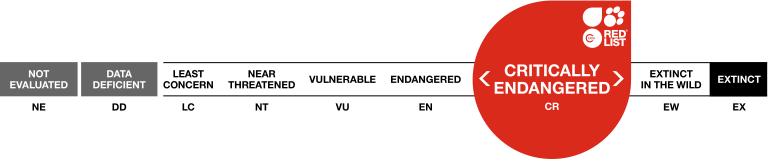
Only a few aquarium hobbyists maintain adult breeding stocks of Stomatepia Pindu, and it is extremely important (because of its IUCN status, listed as endangered) to breed this species and try to distribute it as widely as possible.
What Is It?
As mentioned, its normal coloration is very black, and the Pindù becomes more intensely coloured during spawning periods but will become considerably paler when stressed. Both sexes have very similar coloration, making it fairly difficult to identify individual males and females until they reach maturity. The body is elongated with a more pointed head and snout. The maximum size for males should be around 14-15 cm (6 in), while females are generally slightly smaller, with a few exceptions, as we have some very large gravid females in our breeding colony that are comparable in size to the males.


A high-protein diet helps meet their piscivorous nutritional requirements. They should be fed once a day, late in the evening, and you should wait a little while (30 minutes) before turning off the aquarium lights, then another 15 minutes before turning off the room lights, as this is a naturally shy species that does not appreciate sudden changes in lighting. Since this fish is a mouthbrooder (like most African cichlids), the female picks up the eggs to incubate them in her mouth. Often, the only way to realize that spawning has occurred (as it frequently happens at night) is to observe the brooding female the following day, when her throat appears more square-shaped than usual. The male will remain dressed in a brilliant black coloration afterward.
Breeding: A Major Challenge!
This is a rather difficult species to breed. In our experience, the main challenge is trying to preserve the fry. During the first spawns of young females, attempting to remove the female after a few days and placing her in a separate tank is safer, but because of their shy nature, they often spit out their eggs. These eggs, while incubating, frequently fail to develop and perish within 24 hours.
However, when the fry are removed from the female (caught with a net) and placed separately after approximately fifteen days, they grow very quickly, even outgrowing some of our other Malawian varieties. The fry are very black just like their parents, with one exception: young Stomatepia Pindù have a small tilapia spot on their dorsal fin (a type of small black ocellus), which disappears as they reach adulthood.
The Pindù tolerates other species in the aquarium relatively well (if other species are present), but displays some aggression toward similarly sized specimens, and this intensifies during spawning. Once spawning is complete, the dominant male's aggression decreases considerably. Subdominant males recover quickly if they have been attacked. If you wish to keep this fish, plan ahead, including a large aquarium with plenty of hiding places and refuges for the species. As previously mentioned, the Stomatepia Pindù requires a protein-rich diet.
Unlike other cichlids such as Aulonocaras, Mbunas, and Lake Victoria Haplochromines, with their brilliant coloration, the Stomatepia Pindù remains a very attractive fish that proudly displays its black coloration and elegantly shows off its elongated body. One of the factors in choosing this species is its endangered status... Could that be part of your interest as well?
If so, ask us about them. We have some available from time to time, if you're lucky!
We look forward to help you!