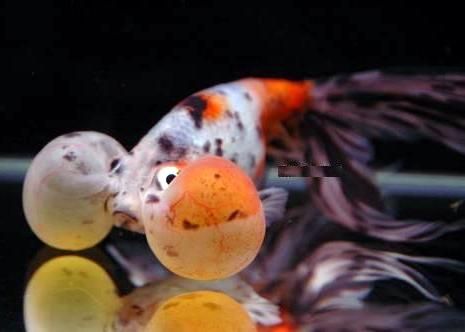
Carassius aureatus Calico Bubble Eyes Goldfish
| Qty (Stock) | Size | Sex | Unit price (Tax included) |
|---|---|---|---|
| Currently Out of Stock! Contact us for more information | |||
IMPORTANT
Keeping fish in an aquarium requires an ethical and responsible approach that prioritizes animal welfare. Purchasing fish for an aquarium should never be an impulsive decision. It is essential to understand the specific needs of each species, including water quality, aquarium size, behavior, and diet. Only fish with similar water quality requirements should be kept together in the same aquarium.
A Little More Information...
The Carassius aureatus, also called Calico Bubble Eyes Goldfish, is an ornamental variety of the goldfish Carassius aureatus. It is recognized by the large fluid-filled sacs beneath the eyes, slow swimming style, and calico pattern combining orange, white, black, and sometimes yellow. This fancy form requires a spacious aquarium, very clean water, and a smooth layout because its sacs are fragile. With generally moderate availability in the aquarium trade, it is best kept in a tank devoted to calm goldfish of comparable size and swimming ability.
General species description
Carassius aureatus is a selectively bred goldfish form developed for its calico coloration and distinctive sacs beneath the eyes. It is not a separate species, but a variety of Carassius aureatus, a cyprinid domesticated in Asia many centuries ago. Its compact body, paired fins, and rounded profile reflect selection for appearance rather than swimming performance. The eye sacs begin developing in young fish and may become quite large with age. They restrict vision and make the fish vulnerable to injury, infection, and feeding competition. An aquarium with a **gentle current**, strong biological filtration, and no sharp decorations is therefore essential. Like other fancy goldfish, this variety produces a substantial organic load and requires regular water changes. It is usually peaceful, but its slow pace means that tankmates must be non-aggressive and unable to outcompete it for food.
Geographical origin and biotope
The ancestor of Carassius aureatus comes from **East Asia**, especially domesticated Chinese goldfish lineages that were later distributed throughout the aquarium trade. Fish sold in Canada are captive-bred; **Indonesia** is an important production and distribution country for ornamental goldfish, including fancy forms. This variety is therefore not a wild fish associated with a specific Indonesian biotope. In an aquarium, it is better to provide the general conditions preferred by goldfish: well-oxygenated, stable, cool to moderate-temperature water in a sufficiently large volume. Rounded sand or smooth gravel, sturdy plants, and open swimming areas are preferable to a dense, sharp layout. Filtration should be effective, but the flow must not create a **strong current**, since the eye sacs and fancy fins make swimming more difficult. Consistent maintenance matters more than recreating a strict natural biotope.
Precise location and local name
In the aquarium trade, Carassius aureatus is mainly associated with **ornamental fish farms in Indonesia**, as well as international production networks for fancy goldfish. This variety is not linked to a natural population or collection locality. In Indonesia, a descriptive vernacular name that may be used is ikan mas koki mata balon calico, meaning “calico bubble-eye ornamental goldfish.” Commercial usage can vary between producers, while the English name Calico Bubble Eyes Goldfish is widely understood in specialist trade. For buyers, the most important points are the condition of the **sacs beneath the eyes**, which should be intact, soft, and free of redness. Fish should swim without difficulty, breathe normally, and accept food. A clearly identified captive-bred source and short transport reduce risks associated with handling this particularly delicate variety.
Appearance and physical characteristics
Carassius aureatus has a short, egg-shaped body, a double caudal fin, and usually a split anal fin. Its **calico** pattern shows an irregular mixture of white, orange, yellow, gray, and black; the pattern varies greatly from one individual to another. Its most striking feature is the pair of large fluid-filled skin sacs beneath the eyes. They develop gradually and may become asymmetrical. These sacs are not additional eyes: they surround and accompany the eyes while limiting downward and side vision. Fins should be intact and scales even. Rough nets, spiny plants, angular rocks, and narrow ornaments should be avoided. Adult size depends on lineage and husbandry; a well-maintained fancy specimen may reach approximately **15 to 20 cm** in total length. The rounded body encourages a calm swimming style, but it may also increase balance and maneuvering difficulties.
General diet
Carassius aureatus should receive a varied, digestible diet in small portions. A staple of **sinking pellets for fancy goldfish** is preferable to floating foods, which may encourage air intake and buoyancy problems in some fish. Frozen or live foods such as daphnia, brine shrimp, and bloodworms can be offered occasionally, along with soft vegetables such as blanched zucchini, shelled peas, or lettuce leaves. Meals should be eaten quickly to reduce water pollution. The fish’s limited vision and mouth position make slow feeding in one consistent area preferable, especially when there is competition. It is better to feed small amounts regularly than to offer one large meal. Very rich foods and excessive protein may contribute to digestive difficulties. A balanced diet supports the development of the **eye sacs**, coloration, and general condition without attempting to accelerate fancy traits artificially.
Essential data
- Original river name:
- Local name used: ikan mas koki mata balon calico
- Origin of the scientific name: Carassius is the Latin name associated with crucian carps; aureatus means golden or gold-covered.
- Full-name etymology: Carassius is the Latin genus name; aureatus is a Latin adjective meaning golden.
- Common/vernacular names: goldfish, calico bubble-eye goldfish, Calico Bubble Eyes Goldfish.
- Family: Cyprinidae
- Subfamily: Cyprininae
- Name pronunciation: ka RASS see us - aw ree AH tus
- Discovery: Carl Linnaeus, 1758.
- Maximum adult size: approximately 15 to 20 cm for this captive-bred variety.
- Water temperature and pH: 18 to 24 °C; pH 6.5 to 8.0.
- Watercourse appearance and surrounding vegetation: slow or still, well-oxygenated water with aquatic vegetation and planted margins.
- Typical tankmates: other peaceful fancy goldfish of comparable size and swimming speed.
- Temperament and behavior: peaceful, social, and slow-moving; actively searches for food near the bottom.
- Water depth: shallow to medium-depth areas in captive settings and calm crucian carp habitats.
- Sexual dimorphism: difficult to determine outside the breeding season; males may develop breeding tubercles and females may become rounder.
- Bottom layout and flow: sand or smooth gravel, open decor, and low to moderate flow.
In your aquarium
To succeed with Carassius aureatus, provide a spacious aquarium, **mature biological filtration**, and stable water parameters. The layout should be smooth and open to protect the eye sacs, while moderate circulation maintains oxygenation without exhausting the fish. Feed small portions and remove leftovers promptly. Tankmates should be peaceful, similarly sized, and slow enough not to monopolize food. Regularly inspect the sacs, fins, breathing, and buoyancy. Careful maintenance, frequent water changes, and a varied diet are the foundations of successful long-term aquarium keeping.
{}