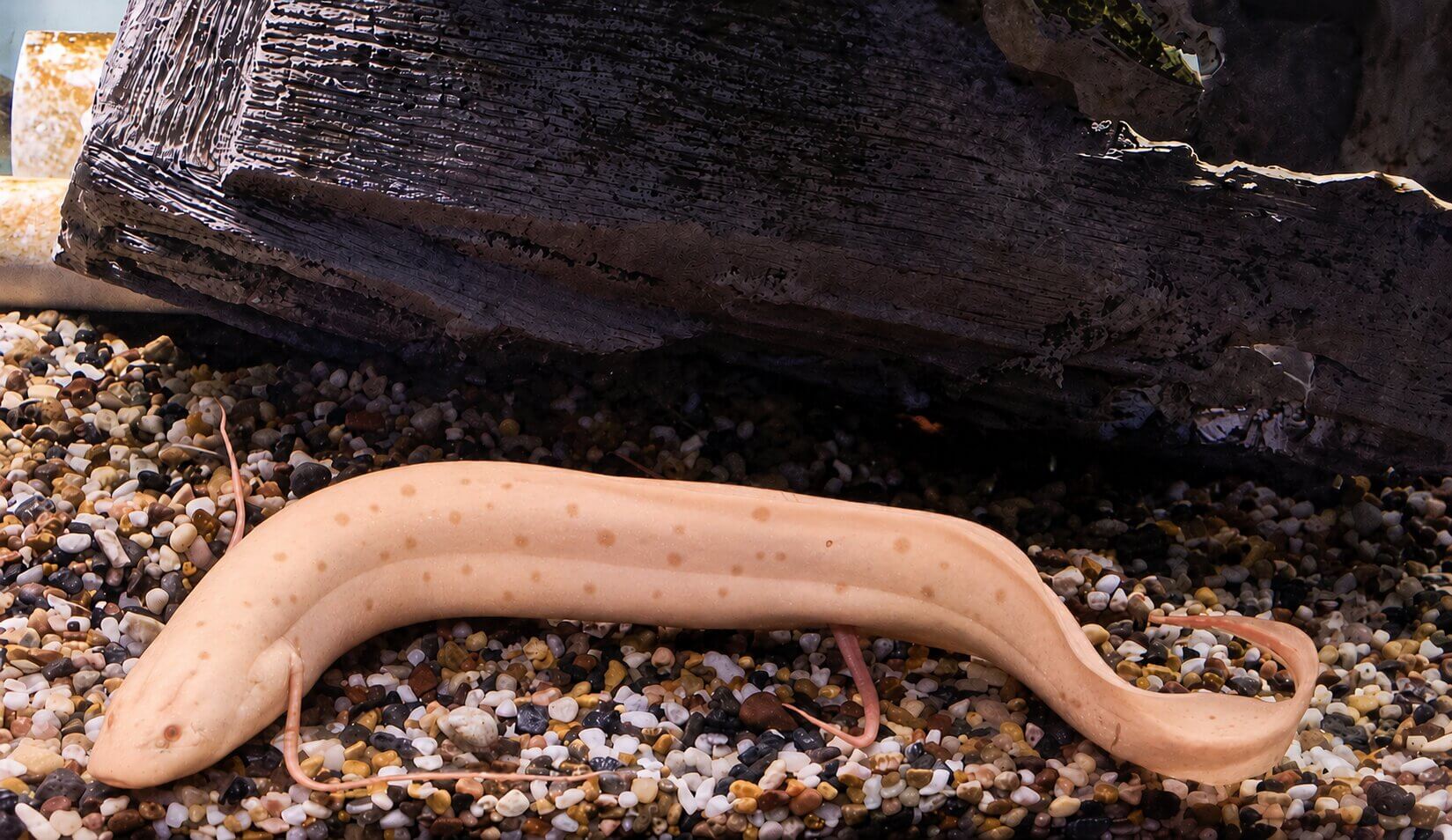
Protopterus dolloi var. Spotted Slender Lungfish Albino
Wild caught origin Exclusive
| Qty (Stock) | Size | Sex | Unit price (Tax included) |
|---|---|---|---|
| Currently Out of Stock! Contact us for more information | |||
IMPORTANT
Keeping fish in an aquarium requires an ethical and responsible approach that prioritizes animal welfare. Purchasing fish for an aquarium should never be an impulsive decision. It is essential to understand the specific needs of each species, including water quality, aquarium size, behavior, and diet. Only fish with similar water quality requirements should be kept together in the same aquarium.
A Little More Information...
Protopterus dolloi var., also called Spotted Slender Lungfish Albino, is an albino form of the African lungfish Protopterus dolloi. This extremely elongated fish has thread-like fins and the remarkable ability to breathe atmospheric air through its lungs. Its pale coloration makes the eyes and vascularized tissues more visible, making it a highly sought fish among specialized aquarists. Like other lungfish, it grows large and produces a substantial organic load. This rare variety therefore requires a spacious, tightly covered aquarium with strong but appropriate filtration, and is best suited to experienced keepers.
General species description
Protopterus dolloi is an African lungfish in the family Protopteridae, adapted to warm freshwater that may contain limited dissolved oxygen. Its serpent-like body, reduced paired fins formed into long filaments, and air-breathing ability give it a distinctive appearance among aquarium fish. The albino form has greatly reduced pigmentation, with a cream to pinkish body and often red or pink eyes. It is an opportunistic predator with steady growth and can swallow relatively large prey. Its commercial rarity is high, so it should be kept by an aquarist able to provide adequate space and long-term security. The specimen presented is listed as **wild collected** and as **exclusive at Ton.Fish in Canada**.
Geographic origin and biotope
Reference countries: Republic of the Congo and Gabon. The species is associated with the Congo Basin and coastal river systems of Central Africa. It inhabits slow to moderately flowing water, side channels, floodplains, and swampy areas where aquatic vegetation and woody debris provide shelter. The bottom is generally made of mud, fine sand, and accumulated plant matter. The surface must remain accessible because the fish regularly comes up to breathe atmospheric air. In an aquarium, this adaptation requires a secure lid while preserving a humid air space above the water.
Precise locality and local name
Geographic records associated with Protopterus dolloi mainly concern western Central Africa, especially the Congo and Ogooué basins. The English trade name Spotted Slender Lungfish Albino describes the offered form: a slender lungfish that normally displays a spotted pattern but has greatly reduced pigmentation because of albinism. Local names may vary according to region and language; in the aquarium trade, lungfish and African lungfish are the most common terms. Because this variety is very rare, it should be identified carefully and kept with all available provenance information.
Appearance and physical characteristics
The body is cylindrical, very elongated, and ends in a continuous fin formed by the dorsal, caudal, and anal fins. The pectoral and pelvic fins resemble long, flexible filaments used for movement and exploration along the bottom. The albino form shows a cream-white to pale pink coloration, usually with reddish eyes and more visible blood vessels. Its mouth is broad and suited to capturing animal prey. Lung respiration is its most important feature: the fish must be able to reach the surface without obstruction. An adult length of approximately 44 cm should be expected, with larger individuals possible under favorable conditions.
General diet
Protopterus dolloi var. is mainly carnivorous and accepts a diet of appropriately sized meaty foods. Suitable items may include earthworms, shrimp, pieces of fish, mussels, and quality frozen foods. Prey should be free of seasoning and offered in reasonable portions to limit excess fat and aquarium pollution. Young fish eat more frequently, while adults can be fed at wider intervals. Varying protein sources and monitoring body condition are recommended because this fish is a **voracious predator** and may attempt to swallow any tank mate small enough to fit in its mouth.
Essential data
- Native river name: Congo Basin; a precise source river is not indicated.
- Local name used: African lungfish; lungfish in the aquarium trade.
- Origin of the scientific name: The name was assigned when the species was formally described.
- Full-name etymology: Protopterus comes from the Greek protos, first, and pteron, fin or wing; dolloi honors Louis Dollo; var. indicates an aquarium variety.
- Common or vernacular names: Spotted Slender Lungfish Albino; albino African lungfish.
- Family: Protopteridae.
- Subfamily: Protopterinae.
- Name pronunciation: pro top TEH russ DOL loy
- Discovery: George Albert Boulenger, 1900.
- Maximum adult size: Approximately 44 cm.
- Water temperature and pH: 24 to 30 °C; pH 6.0 to 8.0.
- Waterway appearance and surrounding vegetation: Slow water, floodplain habitats, dense vegetation, plant debris, and submerged wood.
- Typical tank mates: No tank mate is recommended; small fish may be eaten.
- Temperament and behavior: Generally calm predator, nocturnal or crepuscular, but opportunistic and territorial around shelters.
- Water depth: Shallow to medium-depth areas with direct access to the surface.
- Sexual dimorphism: External differences are difficult to distinguish.
- Bottom configuration and flow: Mud, fine sand, and organic debris; low to moderate flow.
For greater success
Success depends on a very spacious aquarium, a strong secure lid, and filtration capable of handling a heavy organic load without producing excessive current. Keep a clear route to the surface for air breathing, use decorations without sharp edges, and avoid any small tank mate. Warm, stable, and clean water remains essential even though the species can breathe atmospheric air. Handling should be limited and performed gently. Since this is a rare fish listed as wild collected, choose a responsible source, preserve provenance records, and never release it into the environment.
{}